- Home
- /
- Articles and Resources
- /
- Data-Centres
The UK and Ireland data centre market is expanding at pace. For security installers and integrators with the right skills and product knowledge, it represents one of the most commercially significant opportunities in the sector right now.
A Sector in Rapid Expansion
The data centre industry across the UK and Ireland is growing at a scale rarely seen in any built environment sector. Driven by cloud computing, AI infrastructure demand, streaming services, and the broader digitalisation of business operations, the number of data centres being planned, built, and expanded across both nations continues to accelerate.
The UK already holds the largest data centre market in Europe, with London consistently ranking among the top five global hubs. Growth is spreading well beyond the M25, however — the East Midlands, South Wales, Manchester, and the Clyde Valley in Scotland are all emerging as significant new clusters, as operators seek affordable land, proximity to renewable energy, and improved resilience outside the capital.
Ireland has cemented its position as one of Europe's most important data centre destinations. The Dublin corridor hosts hyperscale facilities operated by global technology companies, with investment showing no sign of slowing. Data centres now account for a substantial and growing share of national electricity consumption in Ireland — a measure of how embedded this infrastructure has become in the economic fabric of both nations.
For security professionals, this expansion is not simply a statistic. It translates directly into specification opportunities, project pipelines, and long-term service and maintenance contracts.
Why Data Centres Demand Specialist Security
A data centre is critical national infrastructure. The data processed, stored, and transmitted within these facilities underpins financial systems, healthcare records, government communications, and the daily operations of millions of businesses. The consequences of a physical security breach whether opportunistic or targeted, can be catastrophic.
This reality drives a security specification that goes far beyond most commercial building requirements. Operators routinely reference frameworks including EN 50600 (the European standard for data centre infrastructure), the Uptime Institute Tier classification system, and ISO 27001. Installers working in this space need to understand these frameworks and be able to demonstrate that the systems they install can meet, and evidence compliance with, the expectations within them.
Certifications matter here. NSI Gold accreditation is widely regarded as the baseline for credibility on a data centre project. For fire suppression work, BAFE SP203-1 is frequently specified. Having these in place positions an installer well at tender stage.
Physical Security: A Layered Approach
Data centre security is built around the principle of concentric layers, with each zone harder to access than the last, with every entry and movement logged and auditable.
Perimeter and external. The outer boundary of a data centre site demands robust physical deterrence. High-security fencing, anti-climb measures, and hostile vehicle mitigation (HVM) — including bollards and blockers rated to recognised standards — form the first line of defence. CCTV coverage at this layer requires cameras capable of performing reliably in all weather conditions, with analytics capable of detecting and alerting on perimeter intrusion in real time.
Access control. Multi-factor authentication is standard practice at every access point into the building and within it. Biometric readers, smart card systems, and PIN entry, often in combination — control movement through reception, server hall entry points, and individual cage or cabinet access. Every access event must be logged and retained, with audit trails available for review. Systems from manufacturers including Acre and Honeywell and cloud access solutions from Avigilon Alta and Axis Communications are well established in this environment.
Internal zoning. Within the building itself, security zoning creates distinct areas with separate access permissions. The server hall is typically divided into zones or cages, each accessible only to authorised personnel. Intruder detection — motion sensors, door contacts, and vibration detection on cabinet-level hardware — provides an additional layer of monitoring throughout.
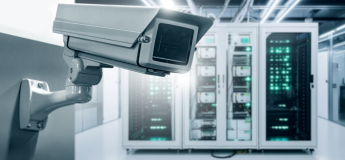
Video surveillance across the internal environment requires wide-angle coverage with no blind spots, reliable low-light performance, and integration with access control so that every access event can be cross-referenced with footage. On larger sites, this generates significant volumes of data, making storage architecture and retention policy a key part of the system design conversation.
Fire Detection and Suppression
Fire risk in a data centre is significant. The combination of high-density electrical equipment, continuous operation, and the irreplaceable nature of the data held means that early detection and rapid suppression are essential, and that the suppression method itself must not cause additional damage to the equipment or data it is protecting.
Early warning aspirating smoke detection (ASD) systems: capable of identifying combustion particles before visible smoke develops are widely specified in data centre environments. Hochiki and Honeywell Fire both produce detection equipment that features in data centre installations across the UK and Ireland.
On the suppression side, clean agent and inert gas systems are the established choice. Unlike water-based suppression, these systems extinguish fire without leaving residue, without causing equipment damage, and without posing a risk to personnel. BAFE SP203-1 certification is the recognised standard for design, installation, commissioning, and maintenance of gaseous suppression systems, and any installer seeking to work in this space should hold it.
The Commercial Opportunity
Data centre projects are complex, long-cycle, and high-value. For installers with the skills and certifications to compete, the returns — across initial installation, ongoing maintenance, and system upgrades are substantial.
The pipeline is not limited to hyperscale or enterprise facilities. Edge data centres, co-location facilities, and private server rooms in commercial and public sector buildings all carry similar security requirements at smaller scale and represent accessible entry points for installers building experience in the sector.
ADI stocks a comprehensive range of security and fire detection products from the manufacturers specified most frequently on data centre projects. Our sales professionals and project teams can support with product selection, project quantities, and next-day delivery to site.